shrey Blog

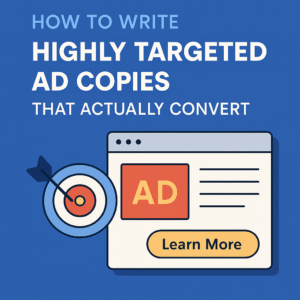
How to Write Highly Targeted Ad Copies That Actually Convert

Highly Targeted Ad Copy: How to Write Ads That Actually Convert 
In today’s noisy digital world, a generic ad copy won’t get you far. If you want your ads to grab attention, spark interest, and drive action, you need to speak directly to the right people — and in the right way.

So, how do you craft highly targeted ad copies that don’t just look good, but actually bring results?

Let’s break it down, step-by-step.


🎯 1. Know Your Audience Like a Friend

Before you even write a single word, get super clear on who you’re talking to.

Ask yourself:

  • What’s their age, gender, job, or location?

  • What are they struggling with?

  • What solution are they searching for?

➡️ Example:
Instead of saying “Buy our skincare products”, say:
“Struggling with dry skin in winter? Try our dermatologist-approved hydration range.”

That feels personal. That connects.


✍️ 2. Use Their Language, Not Marketing Jargon

People don’t search for “performance-optimized hydration products.”
They search for “best cream for dry skin” or “face lotion that works fast.”

Write like your audience talks. Simple, clear, and relatable.

Use tools like:

  • Google autocomplete

  • Reddit threads

  • Facebook group comments

➡️ Pro Tip: Use power words like “instantly,” “proven,” “secret,” “free,” “easy,” and “guaranteed” — but don’t overdo it.


🧠 3. Focus on Benefits, Not Just Features

Features tell, benefits sell.

Let’s say you’re selling a water purifier.
Instead of:

  • “Comes with 7-stage filtration system”
    Try:

  • “Get 100% safe, great-tasting water for your family — every single day.”

Make it emotional. Show the impact.


🔥 4. Add Urgency or Scarcity

A little pressure helps decision-making.

Use phrases like:

  • “Limited stock available”

  • “Offer ends tonight”

  • “Only 3 spots left”

Urgency encourages action — just be honest about it.


💡 5. Add a Clear Call-to-Action (CTA)

Never assume people will know what to do next.

Be direct and specific:

  • “Book your free demo now”

  • “Start your 7-day trial today”

  • “Grab your discount before it’s gone”

CTA should feel natural and aligned with the ad’s message.


📈 6. Test, Tweak, Repeat

Even great ad copies need testing.
Run A/B tests with:

  • Different headlines

  • Varying emotional tones

  • Different CTAs

What works for one audience might flop for another. Data will guide you.


✅ Final Thoughts

Creating targeted ad copies isn’t about being clever.
It’s about being clear, customer-focused, and action-driven.

Speak to the right person, solve the right problem, and guide them toward the right action.

That’s how you write ad copy that converts.


🔍 SEO Checklist for This Blog:

  • Focus Keyphrase: Highly targeted ad copy

  • SEO Title: How to Write Highly Targeted Ad Copies That Actually Convert

  • Slug: /how-to-write-targeted-ad-copy

  • Meta Description (under 160 characters): Learn how to write ad copies that speak directly to your audience and boost conversions with proven targeting tips.


shrey Blog

Let’s be honest — SEO keeps changing.

Let’s be honest — SEO keeps changing.


Just when you think you’ve figured it out, Goo

gle drops a new update and rankings shift like sand under your feet. I’ve been working in digital marketing for a while now, and 2023 taught me a lot — especially one thing:

  • Truth be told, SEO never stays the same

  • Let’s face it — SEO is always evolving.

  • To be real, SEO keeps shifting.

  • Honestly, SEO is constantly changing.

  • No sugarcoating it — SEO doesn’t stand still.

  • The truth is, SEO trends never sit still.

  • We all know SEO is a moving target.

  • Let’s admit it — SEO evolves all the time.

In 2024, SEO isn’t just about ranking. It’s about building real value for real people.

If you’re a freelancer, business owner, or content creator trying to stay visible on Google without burning out — this post is for you.

Here are some SEO techniques that are actually working (and will continue to work) in 2024:Let’s be honest — SEO keeps changing.


1. Search Intent Is King — Not Just Keywords

Earlier, we focused too much on keyword volume. Now? It’s all about intent.
Ask yourself: “What is the person actually trying to find when they search this?”
If you can match their intent with useful content — Google will reward you.

💡 Example:
Someone searching “best running shoes for flat feet” doesn’t want a blog about general fitness. They want product suggestions. Give them that.

 2. Topic Clusters Beat Single Posts

Stop writing random blogs. Instead, choose a core topic and build clusters around it.

📌 One main page (pillar content) + 5–10 smaller related blogs (cluster content)
➡️ All internally linked
Google loves this structure — it shows you’re an expert on the topic.

 3. Update Old Content

Go back to your blogs from 6 months ago and ask:

  • Is the info still relevant?

  • Can I improve the structure?

  • Can I add FAQs or new stats?

  • Let’s be honest — SEO keeps changing.

Sometimes updating one article can give better results than publishing three new ones.

 4. EEAT Matters More Than Ever

Google values who is writing the content.
👉 Show your face. Add author bios. Link to your social profiles.
People trust people — and so does Google.


 5. Fast, Mobile-Friendly Websites Still Win

Even the best content will flop if your site is slow.

In 2024:

  • Optimize Core Web Vitals

  • Compress images

  • Use clean, readable fonts

💡 Use Google PageSpeed Insights or GTmetrix.


 6. Video + SEO = Magic

Short videos improve dwell time and engagement.
You don’t need a fancy studio — just clear audio and lighting.

Digital Marketing

7. Win Featured Snippets

Aim to be the answer Google shows on top.

Tips:

  • Use bullet points

  • Write in Q&A format

  • Keep answers short (30–50 words)


 8. Real Backlinks, Not Spam

Forget spammy directories. Build relationships:

  • Guest post on relevant websites

  • Collaborate with creators

  • Help on forums like Quora/Reddit (value first)

1 backlink from a trusted source > 100 low-quality ones.


🧠 Final Thoughts

SEO in 2024 is about helpfulness.
If you:

  • Create content that solves real problems

  • Build trust

  • Stay consistent

You’ll not only rank — you’ll grow long-term.

You don’t need to be perfect. You just need to be helpful.


📢 Want to See These Tips in Action?

I’ve created a short SlideShare presentation with visual examples.
👉 View the slides here (add your actual link)


✍️ Written by:

Shreyansh Srivastava

shrey Blog

Local seo Kya hota hai

What is Local SEO and Why It Matters for Small Businesses

If you’re a small business owner, you’ve probably heard of SEO—Search Engine Optimization. But what about Local SEO? It’s not just a buzzword. In fact, for many local businesses, Local SEO can be the difference between thriving and barely surviving in today’s digital world.

Let’s break it down in simple terms—no jargon, no fluff. Just what you really need to know.


What is Local SEO?

Local SEO (Local Search Engine Optimization) is a strategy that helps your business become more visible in local search results on Google.

Imagine this:
You’re hungry and search for “best pizza near me.” The results that show up—local pizza places, their ratings, directions, opening hours—are all thanks to Local SEO.

In short, Local SEO helps businesses appear when people nearby are searching for products or services you offer, making it perfect for small businesses like restaurants, salons, gyms, retail shops, and even local service providers.


How is Local SEO Different from Regular SEO?

Regular SEO focuses on ranking your website globally or nationally. Local SEO, on the other hand, is all about getting found in your city or neighborhood.

Here’s a simple example:

  • SEO: You run a blog about digital marketing tips and want to rank for “best SEO strategies.”

  • Local SEO: You run a digital marketing agency in Lucknow and want to show up when someone searches “SEO agency in Lucknow.”

Same foundation, but different goals.


Key Components of Local SEO

Here are the real building blocks that make Local SEO effective:


                                      1. Google Business Profile (formerly Google My Business)

This is your digital storefront. It appears when someone looks up your business name or related services in your area.

Make sure your profile is:

  • Claimed and verified

  • Has correct business name, address, and phone number (called NAP)

  • Contains photos, business hours, and updated services

  • Includes real customer reviews

A well-optimized Google Business Profile can significantly boost your local visibility.


                                                                             Local Keywords

People don’t just search for “dentist.” They search for “best dentist in Kanpur” or “kids dentist near me.”

Use keywords that include your:

  • City or neighborhood

  • Type of service

  • “Near me” variations

Include these in your website content, titles, meta descriptions, and even blog posts.

                                                                          Customer Reviews & Ratings

Believe it or not, reviews impact not only customer trust—but also your ranking.

Encourage happy customers to leave positive reviews on Google, Facebook, and industry-specific platforms.
Respond to every review—positive or negative. Google likes active engagement.


Local Citations

These are mentions of your business name, address, and phone number across the web—on directories like:

  • Justdial

  • IndiaMart

  • Yelp

  • Sulekha

  • Facebook pages

Ensure consistency in your information everywhere. Even a small mistake (like spelling “Road” as “Rd.”) can hurt your credibility.


Mobile Optimization

Most local searches happen on mobile. If your site isn’t mobile-friendly, you’re losing half your audience before they even see your services.

Make sure your website:

  • Loads fast

  • Looks clean on mobile

  • Has click-to-call buttons

  • Easy-to-read contact info


Why Does Local SEO Matter for Small Businesses?

Still wondering if it’s worth your time? Here’s why it really matters:

1. You compete with local businesses, not Amazon.

Local SEO helps level the playing field for small shops against big brands by focusing on location-based searches.

2. Higher conversion rates.

According to Google, 76% of people who search for something nearby visit a business within a day. Of those, 28% end up buying something.

3. It’s cost-effective.

Unlike paid ads, Local SEO is an organic way to bring traffic. Once your profile and website are optimized, you get long-term results with minimal cost.

4. Builds community trust.

Local reviews and visibility in local searches help build your reputation and loyalty in your own area.


Real Example

Let’s say there’s a bakery named “Sweet Crumbs” in Varanasi. The owner listed it on Google, posted regular pictures, used keywords like “fresh cakes in Varanasi,” got 20+ good reviews, and kept the opening hours updated.

Now, whenever someone searches “birthday cake near me,” guess what? Sweet Crumbs shows up at the top—and gets the sale.

That’s Local SEO in action. No big budget. Just smart steps.


Final Tips to Get Started

  1. Set up or update your Google Business Profile today.

  2. List your business on local directories.

  3. Start asking for reviews.

  4. Add local keywords to your content.

  5. Be consistent with your contact info (NAP).

  6. Stay active—post photos, reply to reviews, update timings.


In Conclusion

Local SEO is not a techy thing reserved for experts—it’s a powerful, practical tool that every small business can and should use. You don’t need to be a digital wizard. Just be visible, consistent, and customer-focused.

Start with one step today, and in a few weeks, you’ll start noticing the difference—not just in website traffic, but in real walk-in customers and calls.


Scroll to Top